Thursday, 16 June 2016

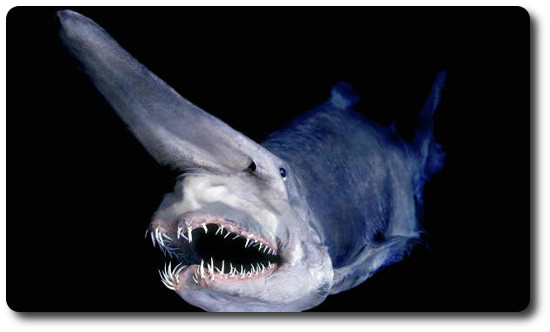
GOBLIN SHARK

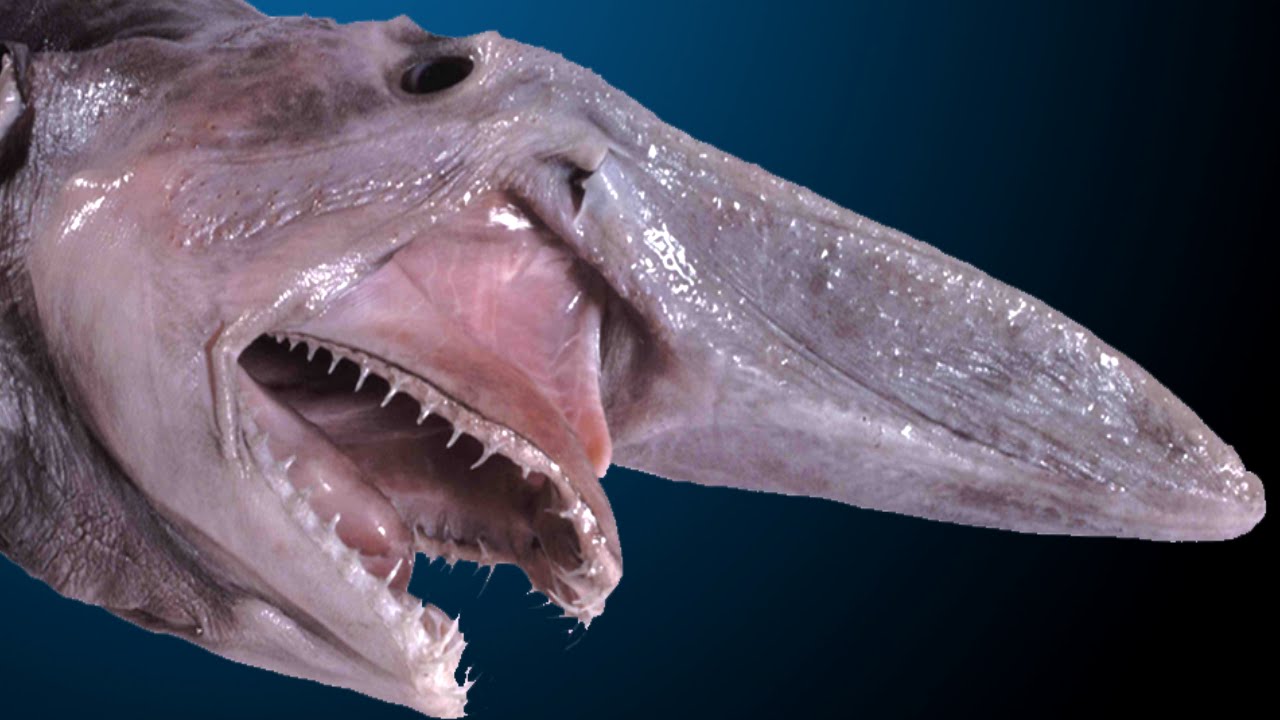
Mitsukurina owstoni also known as goblin shark is a fan of darkness, it does not like sunlight maybe that's why some people refer to it as vampire sharks. I do refer to it as seanicorn from the word unicorn. They feed on creatures deep down in the ocean like crabs, sting ray, etc.

When approaching prey, their jaw goes out and with a sucking motion they draw the into their mouths with powerful teeth waiting to crunch!  The Goblin Shark’s long, slender, exceptionally sharp fang-like teeth are connected to their protruding yet extremely soft and delicate jaws.
The jaws can protrude during eating,giving the goblin a very unusual look. This elongated snout may contain electrosensory canals. Below is a video on our guest...

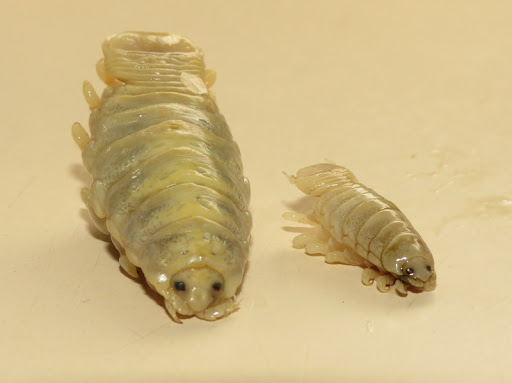
THE TOUNGE-EATING LOUSE


Cymothoa exigua, or the tongue-eating louse, is a parasite of the family  Cymothoidae. This parasite enters fish through the gills, and then attaches itself to the fish's tongue. The female attaches to the tongue and the male attaches on the gill arches beneath and behind the female. Females are 8–29mm and 4–14mm in maximum width. Males are approximately 7.5–15mm and 3–7mm wide. The parasite severs the blood vessels in the fish's tongue, causing the tongue to fall off. It then attaches itself to the stub of what was once its tongue and becomes the fish's new tongue.

They cause loss of blood by using their claws to extract blood from the host after which they replace the host's tongue with their body. *weird*  


It reproduces sexually,  It is likely that juveniles first attach to the gills of a fish and become males. As they mature, they become females, with mating likely occurring on the gills. If there is no female present, within a pair of two males, one male can turn into a female after it grows to 10mm. The female then makes its way to the fish's mouth where it uses its front claws to attach to the fish's tongue. 

It is of no record that this creature is dangerous to man, except if caught alive which may cause it to bite.

Wednesday, 15 June 2016

WHITE ANEMONE

I guess I have to post beautiful things too.

The sea anemone got its name from the flower called anemone flower. They are invertebrates with no skeleton, they are polyps that spend most of their times attached to rocks at sea bottom waiting for that unlucky fish to pass so that it could be entangled in its poisonous tentacles. The body is made up of tentacles all around with the mouth at the center. These tentacles are triggered by the slightest of touches.They shoot filament into the prey that release the toxins which after, they use their tentacles to draw them into the MOUTH. Although the are poisonous to other fishes, some species are known to be highly toxic to human, some even lethal to human because of the level of their toxin.


Tuesday, 7 June 2016

THE BLOBFISH

The blob fish to me still looks like an immature foetus.  Blobfish are typically shorter than 30 cm. They live at depths like 1,200 m (3,900 ft) where the pressure is greater than that of sea level, which would likely make gas bladders inefficient. Instead, the flesh of the blobfish is primarily a gelatinous mass with a density slightly less than water; this allows the fish to float above the sea floor without expending energy on swimming. Its relative lack of muscle is not a disadvantage as it primarily swallows edible matter that floats in front of it such as deep-ocean crustaceans. They have been voted as the world most fish but I've seen quite a reasonable specie that looks normal. 
Blobfish don't bite and they are ok in water. It has never been seen that blobfish was eaten because the moment it touches the earth, it turns to a blob.

In case you are thinking of keeping blobfish as pet,  no one has ever caught it alive except you provide a tank with high pressure. 

Thursday, 2 June 2016

FANGTOOTH

One look at this fish gives me the #wow! Really look. Could fishes like this existThe truth is there are scarier fishes than this.
Fangtooths are beryciform fish of the family Anoplogastridae. The fangtooth is of two types, the common one being about 18cm long and found in the Pacific and Atlantic ocean.

A look at those eyes expresses an evil, gruesome character just like zoom when he's in the mask but I bet it's not that fast. *hmmm*

They consume anything they bump into, even things so large that it affects breathing so they use their fins to wave water onto their gills from behind and breathe.
It seems as if our guest isn't a fan of bright light and only comes up to the surface to feed at night. *werewolf? * *that's lame*


The offsprings are quite different from the adults that they were once thought to be a different species! They look grumpy, with weird spikes protuding out of their head with small teeth. They eat tiny crustaceans too and very soon they grow those big set of tooth which barely fits the mouth. I guess it's one of the reasons the mouth doesn't close fully tho, you don't want to end up with a pierced skull. *lol*


Tuesday, 14 April 2015

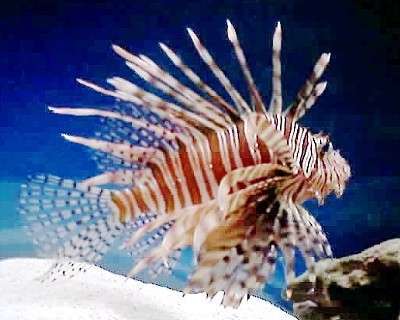
THE LION (PTEROIS) FISH

LIONFISH


The lion fish, also known as ''Pterois fish'' in the Atlantic range from 5 to 45 cm (2.0 to 17.7 in) in length, weighing from 0.025 to 1.3 kg. They are well known for their ornate beauty, venomous spines, and unique tentacles.Juvenile lionfish have a unique tentacle located above their eye sockets that varies in phenotype between species.
Lionfish are known for their venomous fin rays, an uncommon feature among marine fish in the East Coast coral reefs. The potency of their venom makes them excellent predators and venomous to fishermen and divers, (divers be careful). Pterois venom produced negative and effects when tested in both frog and clam hearts and has a depressing effect on rabbit blood pressure. In humans, Pterois venom can cause systemic effects such as extreme pain, nausea, vomiting, fever, breathing difficulties, convulsions, dizziness, redness on the affected area, headache, numbness and sweating. Rarely, such stings can cause temporary paralysis of the limbs, heart failure, and even death. Fatalities are common in very young children, the elderly, those with a weak immune system, or those who are allergic to their venom.
Even with the beauty of the Fish, it's deadly to humans.

OCEAN WONDERS

The ocean might seem to be a pleasant natural scene but have you ever wondered what lives in the deepest part of the ocean? the amazing and deadly creatures in the ocean? Here, you'll find most amazing things